
Naruto’s Five Great Nations and Hidden Villages Explained
Naruto’s five-nation map at a glance
Spoilers: light worldbuilding spoilers, plus references through the Five Kage Summit and later history flashbacks.
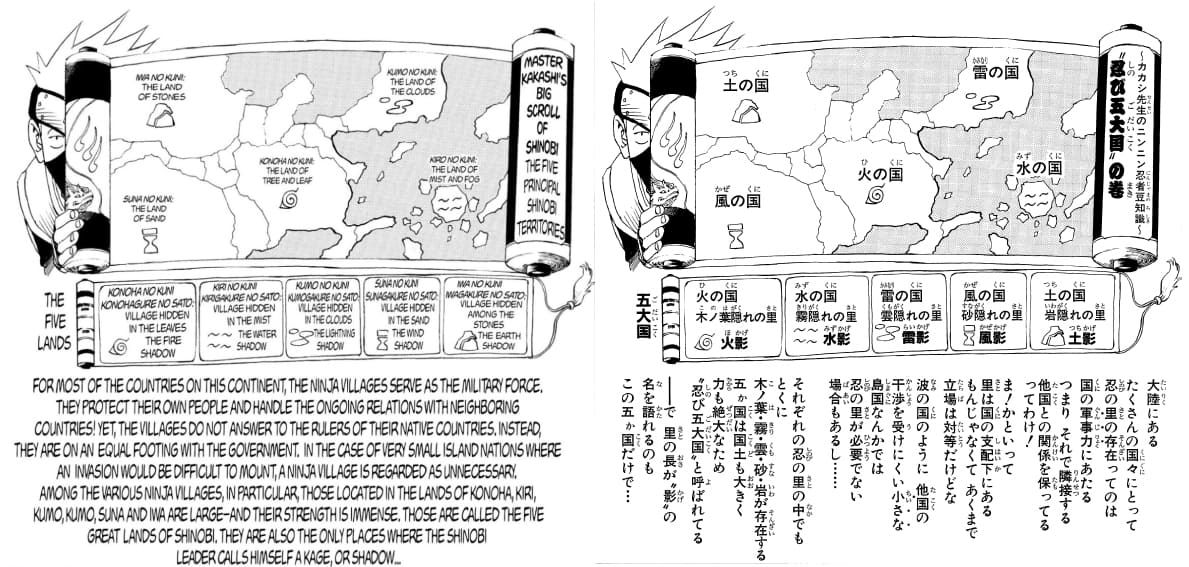
In Naruto, readers often compress three different ideas into one: the country, the hidden village, and the Kage. The series itself treats them as separate layers. An official manga reference panel maps the five major powers as follows and explains that the hidden village is the country’s shinobi military force, not the country itself: official manga reference panel. That same panel is discussed in the official translator interview, and the Five Kage Summit recap independently lists the same village–Kage pairs in story action (official summit recap).
IniTee original kanji apparel
BuzzBeaver’s original single-kanji T-shirts.

| Great Nation | Hidden Village | Kage title | Quick meaning |
|---|---|---|---|
| Land of Fire | Konohagakure, the Hidden Leaf Village | Hokage | Fire country / Leaf village / Fire Shadow |
| Land of Wind | Sunagakure, the Hidden Sand Village | Kazekage | Wind country / Sand village / Wind Shadow |
| Land of Lightning | Kumogakure, the Hidden Cloud Village | Raikage | Lightning country / Cloud village / Lightning Shadow |
| Land of Water | Kirigakure, the Hidden Mist Village | Mizukage | Water country / Mist village / Water Shadow |
| Land of Earth | Iwagakure, the Hidden Stone Village | Tsuchikage | Earth country / Stone village / Earth Shadow |
That is the basic chart most readers need. Everything else is clarification.
Country, village, and Kage are three different things
The country is the nation: Land of Fire, Land of Wind, and so on.
The hidden village is the shinobi center attached to that nation. The official reference panel explicitly presents those villages as the countries’ military power, which is why “Land of Fire” and “Hidden Leaf” are related but not identical terms (official panel).
The Kage is the leader of the hidden village. So Hokage is not another name for the Land of Fire; it is the office held by the head of the Hidden Leaf. If you want the office separated from ordinary shinobi ranks, see our guide to Naruto ninja ranks.
Hashirama’s founding-era retrospective helps make that split clearer. When Konoha is created, Hashirama and Madara forge a relationship with the Land of Fire and aim for “an equal relationship between the Daimyo and shinobi,” showing that national government and village shinobi leadership are not the same institution (Hashirama birthday column).
Where the five-village system comes from
The system starts with the founding of the Hidden Leaf. Official retrospectives say Hashirama and Madara build Konohagakure, create the title Hokage, and establish a model later praised and copied by other nations (Hashirama birthday column; war-era history recap).
That expansion matters. The same Hashirama column says the hidden-village model eventually results in five major villages and the establishment of the five principal shinobi territories, with history’s first Gokage Summit held afterward (official source). So “Five Great Nations” is a specific political-military framework, not a casual label for every ninja settlement in the world.
The Five Kage Summit gives an easy check of the map
A later official recap shows the system functioning in practice when the Kage travel to the summit in the Land of Iron. It lists:
- Hidden Sand Village’s Kazekage: Gaara
- Hidden Stone Village’s Tsuchikage: Ohnoki
- Hidden Mist Village’s Mizukage: Mei
- Hidden Cloud Village’s Raikage: Ay
- Hidden Leaf Village’s Hokage: Danzo
That lineup is time-specific to that arc, but it is useful because it confirms the village-title pairings in plain story language (official summit recap). For the Leaf office specifically, the numbered succession is its own topic; our Hokage in order guide covers that separately.
Why the elemental names confuse people
The five countries use elemental words in their names: Fire, Wind, Lightning, Water, Earth. The five Kage titles use those same elemental words again: Ho-, Kaze-, Rai-, Mizu-, Tsuchi-.
That does not mean a country name is the same thing as a ninja’s personal chakra nature.
A simple official example is Naruto himself. He belongs to the Hidden Leaf, which is part of the Land of Fire, yet the Pain recap identifies one of his signature attacks there as Wind Style: Rasen Shuriken (official recap). In other words, the place-name “Fire” does not lock every Leaf ninja to fire-based chakra.
The same summit recap does this with Ay from the opposite angle. Ay is the Raikage of the Hidden Cloud in the Land of Lightning, and that same article separately describes him as cloaked in Lightning Style chakra during battle (official recap). The repeated lightning word can make the worldbuilding feel more uniform than it really is, but the labels are still doing different jobs:
- Land of Lightning = country name
- Hidden Cloud = village name
- Raikage = office title
- Lightning Style = combat chakra category
So when fans say “the lightning village” or “the fire nation” loosely, they may be mixing levels that the series keeps distinct.
If you want the Japanese characters behind Fire, Wind, Lightning, Water, and Earth in technique names, our Naruto kanji meanings guide breaks those down.
A clean way to remember each nation
If you only want a memory trick, use this formula:
Nation → Hidden Village → Kage title
- Fire → Leaf → Hokage
- Wind → Sand → Kazekage
- Lightning → Cloud → Raikage
- Water → Mist → Mizukage
- Earth → Stone → Tsuchikage
The first word is the country. The second is the village. The third is the village leader.
That structure also explains why the Five Kage can meet together while still representing different countries and different villages at once. The office belongs to the village, but the village stands as the military power of its nation.
Which distinction in Naruto’s worldbuilding was the most confusing before you looked it up?Pick the one that trips people up most often.
Vote to see how everyone else answered
Common questions
What are the Five Great Nations in Naruto?
They are the Land of Fire, Land of Wind, Land of Lightning, Land of Water, and Land of Earth, each paired with one major hidden village and a Kage title.
Is the Hidden Leaf the same thing as the Land of Fire?
No. The Land of Fire is the country, while the Hidden Leaf is its hidden village and shinobi military center.
What does Kage mean in this context?
Kage is the title used by the leader of one of the five major hidden villages, such as Hokage for the Hidden Leaf or Kazekage for the Hidden Sand.
Do the nation names tell you a character’s chakra affinity?
No. The country names use elemental words, but those are geopolitical labels. A character’s chakra nature or technique style is a separate category.
Why is Naruto from the Land of Fire if he uses Wind Style?
Because country affiliation and chakra nature are different things. Naruto belongs to the Hidden Leaf in the Land of Fire, but an official recap still identifies his attack as Wind Style: Rasen Shuriken.
Sources and scope
- Official manga Five Great Nations reference panel
- Leaving "Dattebayo" Untranslated: NARUTO Editor and Translator Share the Complex Challenges Involved in the Manga's Localization
- [Birthday Column] Celebrating Hashirama's Birthday on 10/23! Looking Back on the Founder of Konoha, Who Was Hailed as a "God of Shinobi"!
- [NARUTO 20th Anniversary Column] Retracing the NARUTO Anime's Ninja Way No.6: Two Saviors Arc ~ The Five Kage Assemble Arc
- [NARUTO 20th Anniversary Column] Retracing the NARUTO Anime's Ninja Way No.9: The Great Ninja War: Team 7 Returns Arc ~ The Great Ninja War: Obito Uchiha Arc
More Naruto guides
 Naruto Hokage in Order: The First Through SeventhThe seven numbered Hokage in Naruto, in order from Hashirama to Naruto, plus how Hiruzen’s second term and Danzo’s disputed 'Sixth Hokage' label fit.
 What Does the Will of Fire Mean in Naruto?Learn what the Will of Fire means in Naruto through Hiruzen, Asuma and Shikamaru’s key scenes, and how it differs from the Land of Fire, Hokage, and Fire Release.
 Naruto Kanji Meanings From Gaara’s Love to Ninja VocabularyIdentify seven Naruto kanji, compare their readings in complete words, and choose between the ordinary meanings of 愛 and 忍.
Browse all Naruto Guides.